[PIC #3-2] Optical Interconnects: How AI Data Centers Communicate with Light

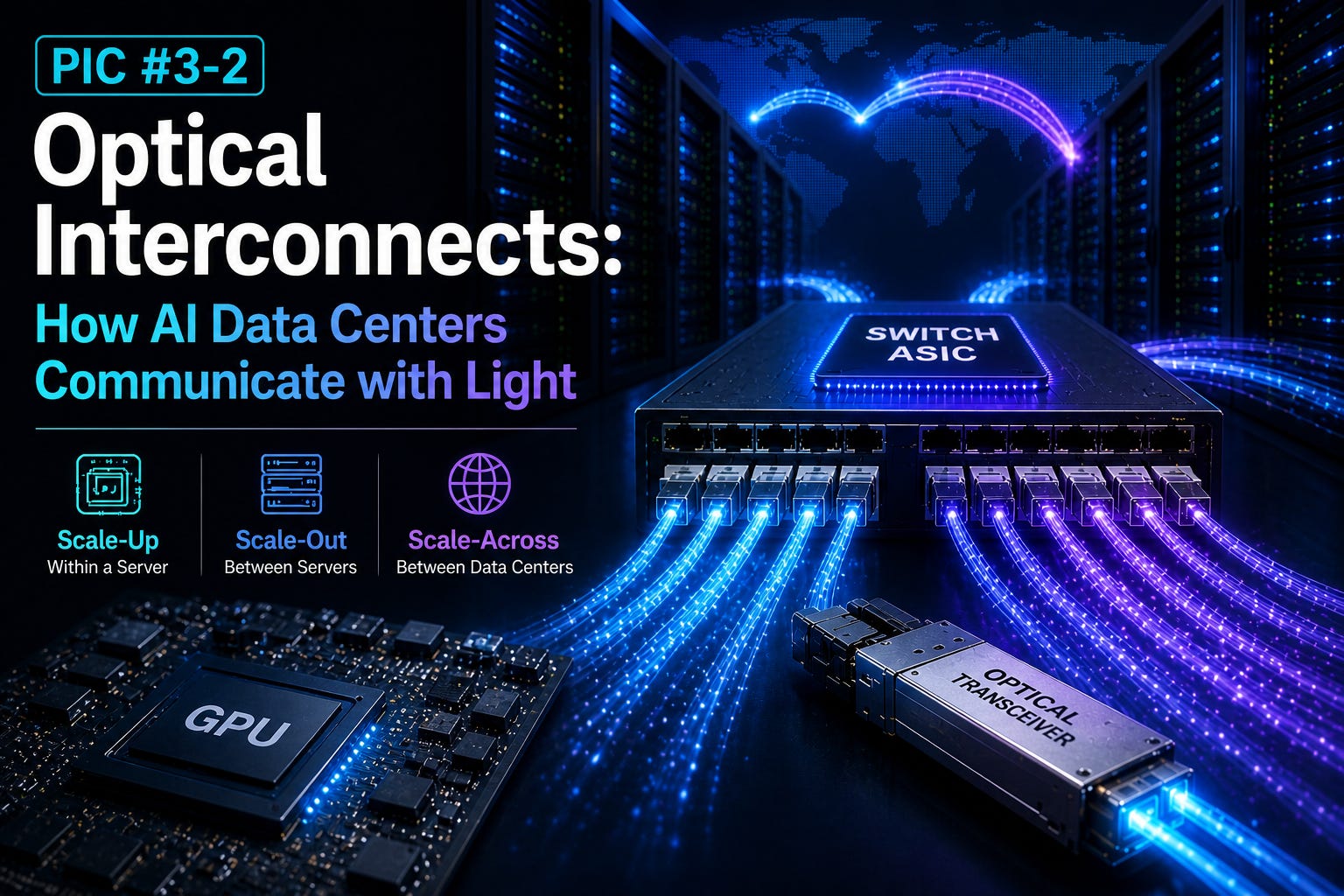
In the previous post [#3-1], we covered GPU server internal connections (scale-up) and inter-server connections within a data center (scale-out). This post focuses on scale-across, the connections between data centers (scale-across).
4. Scale-across: Connections Between Data Centers
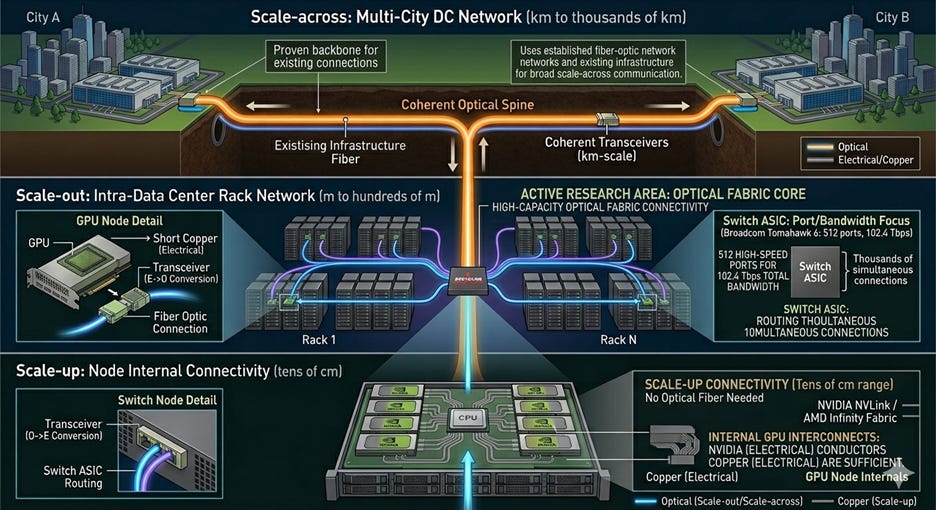
Figure 1. Scale-up (bottom), scale-out (middle), scale-across (top).
The most significant difference between scale-across and scale-up/scale-out lies in the distance data must travel. Rather than connections within a single server or within the same data center, scale-across refers to links between geographically separated data centers—also known as Data Center Interconnect (DCI)—typically spanning hundreds to thousands of kilometers.
As data travels over such long distances, several problems arise.
4-1. The Problem Created by Distance: Signal Latency
No matter how fast light is, distance fundamentally changes the problem. The speed of light propagating through optical fiber is approximately 200,000 km/s. If two data centers are separated by 1,000 km, the propagation delay becomes: (1,000 km) / (200,000 km/s) = 5 ms.
This is by no means a negligible amount of time in AI systems. The time required for data to travel from source to destination is referred to as latency.
Since the speed of light fundamentally cannot be increased, directly reducing latency is difficult. A different approach is therefore required.
“ Transmit more information within the same amount of time.”
The core idea is to improve transmission efficiency by sending more data within the same time window, thereby compensating for the inefficiency caused by latency. This is precisely what coherent optical communication enables.
[ Understanding Bits ]
To aid understanding, let us briefly explain the concept of a bit.
1 bit can select one out of 21 = 2 pieces of information: 0 or 1.
2 bits can select one out of 22 = 4 pieces of information: 00, 01, 10, 11.
4 bits can select one out of 24 = 16 pieces of information: 0000, 0001, 0010, ..., 1111.
Suppose you want to transmit the value “1010” to someone.
Using 1 bit: send “1”, “0”, “1”, “0” separately (4 transmissions total)
Using 2 bits: send “10”, then “10” (2 transmissions total)
Using 4 bits: send “1010” (a single transmission)
Fundamentally, carrying more information per transmission is advantageous in terms of data throughput.
Returning to the main topic: how can we transmit more information within the same amount of time?
Light possesses additional degrees of freedom beyond intensity, which are phase and polarization, and coherent optical communication encodes information using them. Compared to intensity-only modulation, this enables significantly higher information density.
4-2. Coherent Optical Communication: Optical Engine and Digital Signal Processing
However, transmitting more information within the same time window is far more difficult than it may initially seem.
In scale-out networks, communication primarily relies on the intensity of light alone. In coherent communication, however, phase and polarization information are additionally utilized. As a result, electrical signals must be converted into optical signals carrying information encoded in intensity, phase, and polarization, making the architecture of the optical engine significantly more complex.
Moreover, as optical signals traverse hundreds to thousands of kilometers of optical fiber, they become severely distorted by signal attenuation, chromatic dispersion, and nonlinear effects. The device responsible for restoring these distorted signals is the DSP (Digital Signal Processor). In coherent communication, the DSP must simultaneously recover intensity, phase, and polarization information, rather than simply detecting light intensity, making the signal processing extremely computationally intensive. Consequently, coherent DSP performance is considered one of the core technologies of any coherent system.
In other words, coherent optical communication is not merely a technology for “sending light.” More fundamentally, it is a technology for reconstructing the original signal from severe distortion and noise.
In recent years, the coherent optical communication market has seen rapid adoption of coherent pluggable architectures, which integrate what were once large embedded coherent systems inside telecommunications equipment into compact pluggable modules [1,2]. More recently, the industry has moved toward integrating coherent DSPs, PICs (Photonic Integrated Circuits), lasers, and other optical components within a single pluggable module. This offers advantages not only in space efficiency, but also in power efficiency and cost-per-bit [1]. In hyperscale data center environments, such compact pluggable architectures also provide significant advantages in network scalability and operational flexibility.
According to a paper presented by Cisco at OFC 2026, the performance of coherent pluggables is increasingly approaching that of conventional large embedded coherent systems, and pluggable architectures are rapidly becoming mainstream, particularly in the DCI (Data Center Interconnect) domain [2].
The coherent pluggable market is dominated by a small number of companies due to its high technical barriers. Representative players include Acacia (acquired by Cisco), Ciena, Infinera, and Nokia. Notably, Cisco is regarded as one of the very few companies supplying coherent DSPs in merchant form, whereas Ciena, Nokia, and Infinera typically sell integrated coherent systems rather than standalone DSPs.
Further discussion of individual companies will be covered in a separate post. Interestingly, even Broadcom and Marvell, who are dominant players in scale-out networking silicon, do not hold a dominant position in the coherent optical DSP market.
4-3. Coherent Optical Communication: High-Performance Lasers
A conventional photodetector primarily measures the intensity of light. However, because coherent communication must also recover phase information, a different detection method (coherent detection) is used, in which the received optical signal interferes with an additional laser known as a local oscillator (LO). In other words, beyond the laser used to transmit the optical signal, an additional laser is required for phase recovery.
In this process, laser performance directly affects overall system performance. For example, the broader the laser linewidth, the greater the phase noise, which significantly degrades coherent communication performance. As a result, coherent communication requires high-performance lasers with narrow linewidths, high stability, and wavelength tunability.
Lasers for coherent applications with narrow linewidths and high stability also represent a field with extremely high technical barriers, and the market is dominated by only a handful of companies. Representative players include Lumentum and Coherent Corp.
Lumentum strengthened its position in the coherent laser market through the acquisition of NeoPhotonics, a leader in tunable lasers. Coherent, meanwhile, maintains strong competitiveness in InP (Indium Phosphide)-based technologies, which is the core material platform for telecommunication-lasers, and is recognized for its vertically integrated operations spanning InP crystal growth, wafer production, device processing, and packaging.
It is no coincidence that NVIDIA committed approximately $2 billion in advance payments to each of these optical supply chain companies [3,4]. This highlights that, in the AI era, not only GPUs but also the optical component supply chain itself has emerged as a critical bottleneck.
Further details on lasers will be covered in a separate post.
4-4. The Core Challenge: Power Consumption and Heat
Ultimately, the key challenge of coherent pluggables lies in how much performance can be achieved within a constrained power budget and a compact form factor [2]. Power consumption is directly tied to thermal management, making heat dissipation one of the central engineering challenges. In this sense, the coherent pluggable market can largely be viewed as a competition centered around the trade-off between performance and power efficiency.
Recent advances in PIC (Photonic Integrated Circuit) technologies and advanced CMOS process nodes have been major enablers of coherent pluggables. In particular, improvements in the power efficiency of coherent DSPs built on sub-7 nm process technologies have played a critical role in making compact coherent pluggable modules practical [2].
4-5. Discussion
One particularly interesting point emerges here. Instead of investing heavily in companies such as Acacia, which hold strong positions in the coherent DSP market, NVIDIA chose to commit large advance payments to optical component and laser suppliers such as Lumentum and Coherent [3,4].
This arguably reflects the current priorities of the optical interconnect market. From the perspective of today’s AI data centers, scale-out appears to be a more immediate challenge than scale-across. This is because eliminating communication bottlenecks within GPU clusters and inside data centers is currently one of the most critical constraints on AI system scaling.
That said, this does not imply that scale-across is becoming less important. Coherent optical communication remains highly important and will likely become even more critical in the future. As traffic between AI data centers continues to increase, demand for scale-across network bandwidth is also expected to grow rapidly.
Interestingly, coherent optical communication is no longer confined solely to long-haul telecommunications. There are increasing efforts to bring coherent technologies into shorter-reach scale-out environments within data centers as well [1]. In relatively short-reach environments such as intra-data-center networks, coherent systems can potentially operate with lower DSP complexity and reduced power consumption compared to traditional long-haul coherent systems. In addition, because signal distortion is less severe over shorter distances, there is also the possibility of reducing overall system complexity and cost. This direction is often discussed in the industry under terms such as coherent-lite or low-power coherent [1].
However, coherent communication still requires substantial power consumption and high-cost technologies across DSPs, lasers, and optical packaging. As a result, achieving economic viability in short-reach applications remains a significant challenge.
5. Conclusion
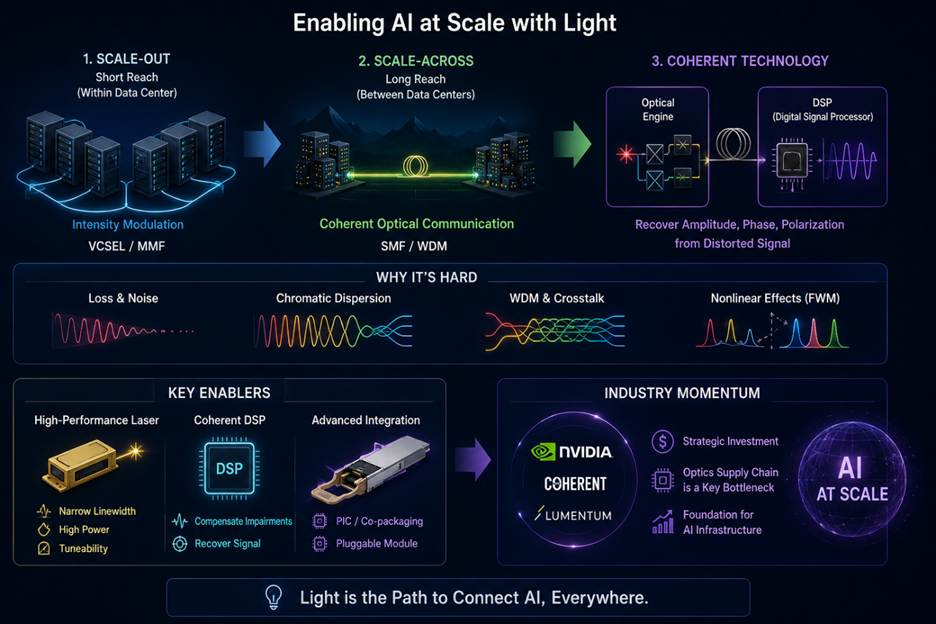
To summarize briefly, scale-out communication primarily transmits information using the intensity of light, whereas scale-across communication additionally utilizes the phase and polarization of light in order to deliver far more information within the same time window over long distances.
However, coherent optical communication is not simply a technology for transmitting more data. Because optical signals become heavily distorted and degraded while traveling hundreds to thousands of kilometers, high-performance DSPs (Digital Signal Processors) are essential for reconstructing the original signals. In particular, coherent DSPs must simultaneously recover phase and polarization information, requiring extremely high computational complexity and power consumption.
Ultimately, the key challenge of coherent optical communication lies in optimizing the trade-off between performance and power consumption.
Finally, in this post, I attempted to explain the core concepts behind modern optical interconnects in the most intuitive and accessible way possible. In particular, I focused on how these technologies are evolving and why they matter. I also briefly introduced several representative companies in order to connect technologies to the broader industry structure.
I have always preferred a bottom-up approach to writing. Applied to these posts, that means first building an intuitive understanding of the overall technological landscape and its core concepts, without necessarily diving immediately into every technical detail, and then gradually connecting that understanding to the technological positioning of companies and the structure of the industry itself.
(Optional) Appendix: Factors Contributing to Signal Quality Degradation
In scale-across, the long travel distances and large information volumes of optical signals lead to significant signal distortion. This appendix briefly describes the specific types of signal distortion involved.
6-1. Signal Quality Degradation: Noise Accumulation
Signal Attenuation and EDFA
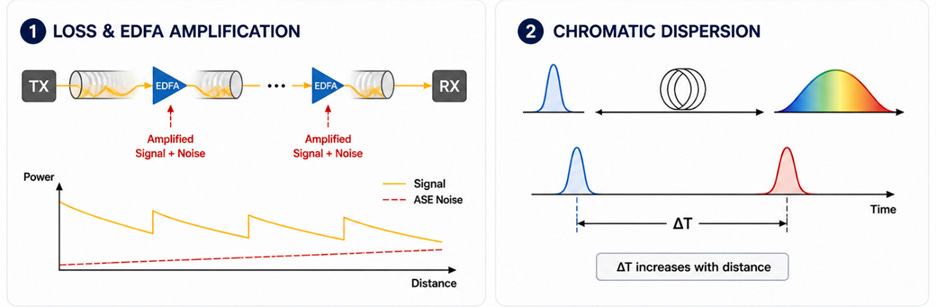
The first issue is signal attenuation. No matter how low the loss of an optical fiber may be, the accumulated loss over hundreds to thousands of kilometers cannot be ignored. It is therefore necessary to amplify the weakened optical signal at regular intervals, and the device that performs this function is the EDFA (Erbium-Doped Fiber Amplifier).
However, the EDFA amplifies not only the signal but also the noise. As a result, as optical signals travel longer distances, signal quality, measured by OSNR (Optical Signal-to-Noise Ratio), progressively degrades.
Chromatic Dispersion
The second issue is chromatic dispersion. Even a nominally single-wavelength laser has a finite spectral linewidth in practice, meaning it is not composed of a perfectly single wavelength. Within an optical fiber, the speed of light varies slightly with wavelength, which is a phenomenon known as chromatic dispersion.
As a result, signals that initially travel together gradually spread apart in time and begin to overlap with one another. For SMF-28 optical fiber, the dispersion coefficient is approximately 17 ps/nm/km [5]. This means that two light signals with a wavelength difference of 1 nm will arrive approximately 17 ps apart after traveling 1 km.
For example, consider a signal with a spectral width of 0.5 nm traveling 1,000 km. The time spread due to dispersion would be: 17 ps/nm/km x 0.5 nm x 1,000 km = 8,500 ps.
Given that the symbol period of a 400G transceiver is on the order of tens of picoseconds, a time spread of 8,500 ps is by no means negligible; countless symbols would overlap, resulting in severe noise. This also underscores why a narrow laser linewidth is critically important.
Inter-Channel Interactions in Wavelength-Division Multiplexing (WDM)
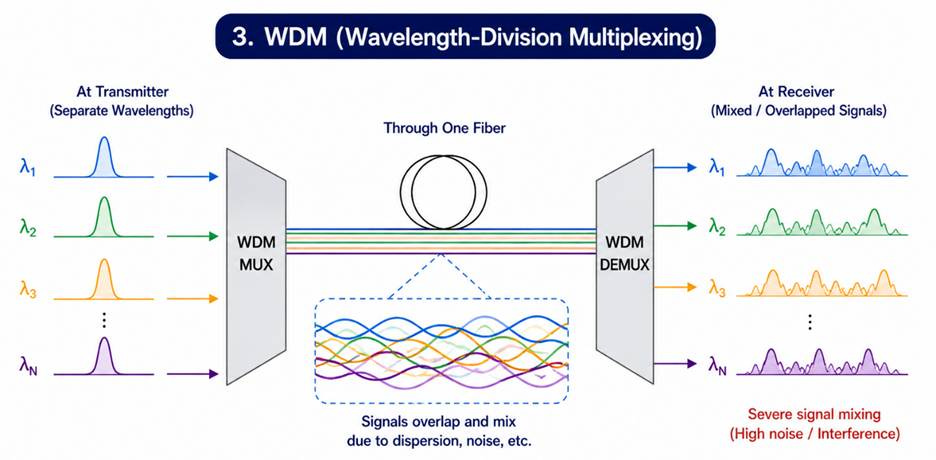
The third issue is inter-channel interactions in WDM (Wavelength-Division Multiplexing) environments. In actual coherent optical communication, rather than transmitting a single wavelength through one fiber, multiple wavelengths are transmitted simultaneously, since this allows far more data to be transported within the same time. This is called WDM, and it enables significantly higher data throughput on a single optical fiber.
However, the simultaneous presence of multiple wavelength channels greatly increases system complexity. Each wavelength has slightly different dispersion characteristics, and inter-channel interactions can also occur within the fiber. Consequently, long-distance transmission faces far more complex signal distortion and channel crosstalk than single-wavelength systems.
Nonlinear Effects
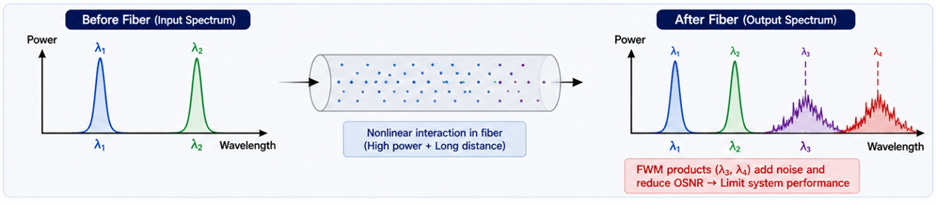
The fourth issue is nonlinear effects in optical fiber. A representative example is Four-Wave Mixing (FWM). When two or more wavelengths travel together through an optical fiber, the nonlinearity of the fiber can generate new wavelength components.
In particular, the more similar the speeds of different wavelengths, the longer those signals overlap as they co-propagate, and the greater the FWM efficiency. New wavelength components that did not originally exist are thereby generated, acting as a significant source of noise.
Interestingly, fiber dispersion (the fact that different wavelengths travel at slightly different speeds) has an unexpected mitigating effect on FWM. Because dispersion causes wavelengths to separate temporally and spatially, it reduces the likelihood of FWM occurring.
Ultimately, the core challenge of scale-across is the restoration of distorted signals. As optical signals travel long distances, signal loss, dispersion, nonlinear effects, and channel interference accumulate, severely degrading signal quality. The essence of coherent optical communication therefore lies in how accurately the distorted signal can be restored.
References
[1] Nokia Corp., “ Advanced Technologies in Coherent Pluggables and Use Cases,” OFC, 2026.
[2] CISCO, “Next-Generation Coherent Optical Transmission Systems and Practical Optimizations,” M2C.1 OFC 2026.
[3] NVIDIA, “NVIDIA Announces Strategic Partnership With Lumentum to Develop State-of-the-Art Optics Technology,” March 2, 2026. https://nvidianews.nvidia.com/news/nvidia-announces-strategic-partnership-with-lumentum-to-develop-state-of-the-art-optics-technology
[4] NVIDIA, “NVIDIA and Coherent Announce Strategic Partnership to Develop Optics Technology to Scale Next-Generation Data Center Architecture,” March 2, 2026. https://nvidianews.nvidia.com/news/nvidia-and-coherent-announce-strategic-partnership-to-develop-optics-technology-to-scale-next-generation-data-center-architecture
[5] Corning, “Product Information: Corning® SMF-28® Ultra Optical Fiber Product Information.” https://www.corning.com/media/worldwide/coc/documents/Fiber/product-information-sheets/PI-1424-AEN.pdf
nice one .. thanks for sharing such useful information for the non technical persons